
12.53 : Steve :
Welcome to the Small Is Beautiful live blog 2015! Brought to you by the combined fast and furious typing skills of @solobasssteve and @robotnic.
17.30 : Steve :
“In 2007, Rob and I found ourselves deeply depressed, but hadn’t seen that the scale of the change in our lives, the newness, was putting us under massive strain. We need to have an honest conversation about those 3am moments. When you’ve over-committed. Because the start-up life is a different kind of life. People are happier at work, but busier and more anxious.
“It’s wonderful to work alone, but not to be lonely, to feel misunderstood by those closest to you. Especially when you’re making your living with something that is near and dear to you, something of yourself, there’s a huge risk of pain. And we fail. Sometimes people blow their savings and it still doesn’t work. It never gets there. And what we tell ourselves about those moments becomes really important. It’s a shameful moment, but can we find a different narrative about failure?
The founders life for all its perks, has some complicated roles and demands. Being a carer in your work day is a different kind of juggling act that 9-5ers don’t have.
There’s increasing interest in this topic in the start-up community, largely due to the tragic deaths of some of the leaders in the start-up movement, like Aaron Swartz. “This can go badly, we lose some of our greatest minds, they can no longer sustain the internal and external pressure. The stakes are high when you’re thinking about how to take care of your inner self, your soul. It must be tended well.
There’s a long established relationship between mental illness and creativity. Sometimes it’s ‘mental difference’ but for some it’s real pain, real suffering. Some can adjust their life around what’s happening biologically, so we’d see higher rates of mental illness if these creative folk weren’t adapting to the trouble.
I want to talk about Anxiety – unavoidable, deadly, helpful. it’s part of life, it’s an adaptive response. It’s also, as experienced in our modern lives, can be deadly. We’re seeing more chronic anxiety. It doesn’t come and go, it’s long term.
But Anxiety is also helpful, it saves us from the tiger, but also keeps us motivated.
“First time entrepreneurs were more likely to be prescribed anxiety medication than matched controls”
Clearly, too much anxiety is bad for your life and business, so how to we make friends with the bit of it that is useful?
Plotting Performance against arousal, you need to be a bit anxious to be more productive, but high anxiety kills performance, and it’s even more true for novel or creative tasks.
How do you find a place where you have enough anxiety to focus but not so much that you’re afraid?
I think this comes down to protecting your inner life, not living in a way that’s reactive not just responding to whatever stresser is coming your way, but having a deep sense of self that exists outside of the daily pressures and expectations. Protecting your inner life.
A lot of people talk about work/life balance – I don’t like that language, but it does communicate that balance needs recalibrating, it’s not a thing you do once.
So here are two clusters of balance strategies – the first is taking time out, allowing yourself to change perspective outside of work, to allow yourself to exist away from it. It’s hard, you’re passionate about your work, but I’m going to encourage you to diversify yourself more.
Strategies for taking time out – you have to get good sleep. The science that we know about sleep is so compelling. Watch the TED talk about why we sleep. When we sleep our brains are so active, working on pretty high level cognitive tasks. MRIs show this. It’s quite possible that while our bodies are taking a break, our brains are solving the days problems. So instead of powering through, go to sleep and let your brain do it.
Having the discipline of caring for your body is v much a part of caring for your soul. We out of the cartesian body/mind split era.
Second one – nutrition and exercise. Set limits and keep them. Put parameters around your work. Let yourself diversify.
Take screen breaks. We do screen-free sundays. Time for games and going out. Taking time away gives me power of those tech things, I feel more in control because I can take time away.
PLAY! If you have kids you have the open invitation to this. Do a new creative thing, be more than your work.
Serve – be aware of what’s around you, protect the earth, your environment, look after the poor. It brings a part of us alive that discovers we can be helpful.
Another strategy – TIME IN. Engaging your work in a deeper way.
Have an inner circle, people you meet with who will give you real authentic feedback about your business and work. The discipline of letting others into what you’re thinking about, getting some feedback and some new thoughts. Who do you trust to be part of your feedback loop?
10,000 hours to make an expert – but when we really look at that, it’s not that they do it over and over again, it’s that they do it with a coach, with someone who’s giving them lots and lots of feedback. If you’re simply doing your work over and over, 10K hours of wrongness is still wrong. You’re great at being wrong. You need feedback.
SELF REFLECTION – important in our worklife to consider personal metrics. Asking similar questions to web metrics, record a daily check in (St Ignatius question of what was life-giving, what was not). It’s a way to keep track of what is working for you in your life and what isn’t. It’s been a really powerful practice for me, it showed me that the professor tragectory I was on was the cause of all the negativity in my life, but the things I loved were in my clinical training.
So having this data helped me leave the tenure track job.
The way to keep track of your journey is to observe it but not judge. Banish the words ‘should’, ‘must’. Just keep track of the things you hate each day.
GRATITUDE – practice gratitude, keep a journal of gratitude. Build it into meal times. Research suggests it improves immune function and relational connection.
These might seem disconnected from your work, but if your work is of you, this stuff is central to what you do.
RETREAT – TIME IN. This is not time out, not a holiday, not beach time, this is very intentional careful thought time, where you are going for 48 hours or more, stepping out of your life, screen-free. I ask myself a load of questions, it’s a way of engaging with your own thoughts that’s out of the norm. Focus on specific questions – high and low points, mapping out goals or dreams, asking should I begin/continue/end – grit is a great quality unless it means you don’t ask whether you still need to do the thing you’re doing? Re-examining every aspect of your life and work. I can’t do this in my week, on the fly. Make decisions and follow through. Let this be a decision making time.
there’s a discipine in honouring the part of you that won’t let you be an accountant, that lets you do something different, to make your own thing. To make your mark. Nourish that part, honour it. The greatest thing in the world is to know how to belong to one’s self. The other greatest thing is that if we have no peace it’s because we’ve forgotten how to belong to each other.
16.59 : Steve :
Final speaker – Sherry Walling – http://www.sherrywalling.com/
“Small is beautiful… and really really hard.”
“Normally when I give lecture talks, they’re in hotel conferences suites, so this is as good as it gets (takes selfie)
“I’m here to talk about how small is beautiful and also really hard.
“There are fab success stories. I’m not a micro or a founder or a creative. I’m a psychologist, sad people come and talk to me. In my best moments I feel creative in that when it’s going well, I help people pick up the pieces of what has been to make a new picture. I also come to this from the perspective of the wife, having co-journeyed with Rob from being an employee to a consultant to whatever it is he does now…
“This kind of work requires something from the deep place within you that is different from accountants… it’s from a deep place you have to pay acute attention to in order to sustain you.
“I love you Jocelyn Glei talked about total freedom meaning total responsibility. That was great, but at 3am when you’re not sure if Google is about to ruin your business by changing an algorythm. At that point it’s ‘FUCK! I have total reponsibility, resting on my creativity” That’s scary!
“You’ve heard from many of your speakers that it all rests on your own ability to pull everything together….
16.50 : Steve :
now up Neil McGuire of After The News.
Typography and Trust.
Ideas and Imagination.
Detail + Generalisations.
I’m a graphic designer, @offfbrand on Twitter.
When I talk about After The news, I often talk about we, because I rarely do anything completely on my own.
No good designers that I know, except James Dyson (ha!)
We work in networks that resemble hypertext, in nodal networks.
BTW, there’s no useful business advice in this talk.
I see my business as an elaborate way of funding a book buying habit. 🙂
I’ve never wanted to be rich, and that’s been my greatest success 🙂
One of thing I wanted to say about the art school where I work – it’s a small institution related to other unis, but a huge one compared to the scale of my work. And it works best when it behaves like a network not a heirarchy.
Hat-tip to Ivan Illich – https://en.wikipedia.org/wiki/Ivan_Illich
To me, smallness is a political thing.
Here’s the Crispin Jones watch Neil just mentioned – http://www.watchismo.com/mr.-jones-the-accurate-watch.aspx
(this talk really is just a collection of really interesting sentences 🙂 – steve )
Design is a verb not a noun.
What are the affordances of smallness?
(now it’s just a collection of interesting phtos that are being described.)
“This is probably annoying cos it’s just like seeing someone’s holiday photos”
“I think it’s important to rethink what being serious in work means. The great benefit for me is that I don’t need to be serious – that doesn’t mean flippant. As soon as stuff becomes more important, people get more serious, and it’s important to break that.”
MOOCS – massive online open courses. They’re interesting but they highlight that things that are expereriental have more value in this space. That there’s a race to bottom in terms of distributing content, but you can’t do experience distro.
more interestingness – http://parallel-school.org/Â
Another project – Fashion and Cultures – this is the detail bit I promised. It’s a short festival happening soon. As a designer I’m interested in typopgraphy, in forms. The serifs on typefaces are a hangover from angled scribes.
Adoni is strongly associated with fashion. Was designed in the late 1700s, when printing tech was getting better. Through their elegance, they became synonymous with fashion typography.
This idea that typefaces could have clothes, elements to them that are on top of their skeleton form.
(I’m missing bits of this because any distraction causes me to miss another three sentences, which is three new topics!)
Digital – the tech affords certain things. If you want to know what’s happening in digitech, go to the loos in Stereo and read the graffiti. 🙂
Designers born after 1980 have a totally different way of seeing visual culture.
(more pictures being described)
(I’ll put the audio up ASAP, but that’ll still be pretty mixed up without the pics.. it’s actually pretty mixed up with the pictures, but in an awesome way 🙂 )
16.26 : Steve :
Hannah:
“Front cats to elephants – the elephant in the room, which is of course that the tech solutions use the earth’s resources. So the hardware here uses silicon, which is running out. Most of us have over 3 devices. Most of us replace at least one of them every 18 months. WE’re bringing tonnes more devices into the world. So the best thing we can do is to pass them on or send them back for recycling.
“Digital devices use electricity and that causes emissions, so we can use solar chargers. We can run laptops on batteries between charging.
“Most of the big social networks are using server farms that are A rated for energy efficiency. We can ask for that from our hosting.
“I do believe that protecting our common wealth and habitat will require us all to intervene, to do what we can in our contexts. It’s easy being green if you make it a focus where your enviro-sustainability part of your agency. Your gritty stance against transnational governmental profligacy
“we can do the small green thing, to influence the big with our integrity, we can make changes to our business through core work or partnering.
“as Andy Warhol reminded us – they always say time changes things, but actually you have to change them yourself.”
16.22 : Steve :
where the event went the 2nd year:
16.20 : Steve :
Hannah
what sharing your green activity on social media does is it normalises those behaviours.
Whatever we do, we need to use more ways of encouraging the personal engagement of our audience, clients, customers.
Hannah talking about http://blogs.walkerart.org/openfield/
16.13 : Steve :
Hannah:
“You can install energy efficient appliances with a grant.
I want you to show off about the small green things that you can do. Try holding meetings on skype or google hangout – it’ll reduce your carbon footprint and your costs.
“if you do have to travel, consider using claimexpenses.com which tracks expenses and your CO2.
‘if you work online a lot, I’d encourage you engage through clicktivisim. People are cynical about it but you can speak truth to power digitally – 100,000+ petitions can be debated in parliament.
“today is world environment day – and Dave Cameron decided that would be a great time to change to law to allow fracking everywhere. Greenpeace launched a petition today, and turned up at his house as ‘frack and go’ to drill there!
“Go and shout about what you’re doing, share it on your social channels.
“
16.09 : Steve :
all of hannah’s links in her talk at at https://delicious.com/hanrudman/smallisbeautiful
“I’m doing envirodigital mostly pro-bono at the moment, because people doing get how important it is.
“there are technologies you can engage with now to help monitor your energy consumption. For example, Hive. With a mobile app you can monitor your heating.
“Or Watson and Holmes. http://www.holmesautopilot.com/
16.06 : Steve :
Hannah:
“therefor, if we’re concerned about those things, we need to think about how we respond.
“Kermit summed it up – it ain’t easy being green.
“Has this depressed anyone? That was the point. Maya Angelou said people will forget what you say and do, but not how they make you feel – I want to depress you, to drive you to make yourselves feel better.
“i want to share some ideas about what we can do to take a stand against the media and politicians on this.
16.03 : Steve :
First up after the break – Hannah Rudman.
“A huge body of science has built up over the last few years that Climate change is anthropogenic. 97% of scientists agree on that. Simultaneously we’ve been cutting down the earths natural way of absorbing that, and the sea’s becoming more acidic, so sealife is dwindling.
“We’re also depleting the world’s resources. Add to that the growing population of the earth and their consumerism, and it has the potential to cost us the earth.
“WE’re in denial – only 26% of humans believe in global warming.
“The RSA called this phenomenon stealth denial.
“Our current human response is emerging as a bit of a tragedy. The knowledge of the reality gives us a moral imperative to act, but it’s diluted at every level – media misrepresentation, by international govt. failure to agree on emission treaties, and by us collectively mischaracterising the climate problem as only an environmental issue.
“in fact it’s a global threat to finance, health and security.
“therefor it’s in our biz interest to care about that.
15.49 : Steve :
Here’s Karine Polwart’s beautiful talk from earlier. Well worth a listen:
12.40 : Steve :
…I’m reminded by Rob’s talk of this Ira Glass talk:
12.38 : Steve :
Rob:
“Rule #7 : Ship : If you create art and no-one sees it, it doesn’t matter. And by art I mean everythign you do. But if any of our art is not seen by somebody else does it even matter? And if you don’t ship it, no-one will see it. People don’t ship because they are scared of failure. But the first time you do something is terrifying, my first blog post was terrifying. It didn’t matter, hardly anyone read it. Now 300 posts later, I don’t even think about it. First ever podcast I did – 2 hours to record, 20 hours to edit. Now 45 minutes to record and we hire an editor. There are mistakes in every episode and no-one cares.
“It’s easy to be great, it’s hard to be consistent”: Steve Martin – the great comedians were the ones who could repeat it.
So my encouragement to you is ‘ship a new product every X’ – and work out what X is. Be consistent.
12.34 : Steve :
Rob:
“If you find yourself saying ‘I’ll do it when…’ these are all asking for permission things, from someone and it’s a dangerous way to go.
Rule #4 – Build An Email List : the term ‘digital share cropping’ was coined by copyblogger – share cropping was when a farmer would work land owned by a rich farmer, and the subsistence farmer would end up with nothing. The digital parallel is that if you’re building your audience on someone else’s list then you’re in danger of being cut off from the people who want to hear from you. Email is the way around that.
Rule #5 – There Is Power In Working Alone : unless you have someone you would consider starting a marriage with, do it alone.
Rule #6 – Don’t Try To Do Everything Yourself : I had a friend who would make blankets and sell them at farmers’ markets, she worked really hard for less money, but she wasn’t willing to let go of some pieces of her project – the cutting, the selling, and that’s not a sustainable lifestyle. If you want to do this for the long haul, think of the things taht you can parse out. if you can find someone who can do it 80-90% as well, you’ll be better of. Especially if you’re doing purely digital stuff, a virtual assistant is a huge, huge help.
12.27 : Steve :
Rob:
“I have 7 rules I’ve found through my experience of trying to launch products and gain freedom and independence.
Rule #1: Build Products. I find a lot of people who think about freelancing as hourly pay, but that’s not self-employment, that’s a job with more bosses. So let’s forget freelancing, consulting for now, forget dollars for hours, and start thinking about building products – books, games, songs, performances, wordpress themes, films. The idea is to build it once and sell it for ever.
Rule #2 Freelancing Is Dangerous: I’m not telling you to quit, but a lot of people think that ditching their salaried gig is the route to freedom, and often the opposite is true. The typical reality is we make less money, work harder, and get late night phone calls. Freelancing is tempting but it’s a vortex that sucks you in. “If I make one more hour I’ll make £50, so why would I spend it writing this book?” it’s hard to justify not making you hourly rate.
Rule #3 Don’t Ask For Permission : in software startups everyone talks about being the next big thing, but I see capable people making spreadsheets and powerpoint presentations instead of products. My son came to me and said me wants to make a movie when he’s older. So I said, why not do it now? So we made a stop motion video. He knows you don’t have to ask for permission, whether that’s age or money or whatever..
12.21 : Steve :
Rob:
“I’m going to talk about failure, shipping and working alone.
I imagine most of you aren’t familiar with what I do – so here’s a brief overview.
“I have three main software products, these three did just under half a million dollars in net profit.
the other side of my business is the teaching, blogging conference work, helping others doing the same thing…
I wrote a book “start small stay small” – I was approached by two publishers, but I didn’t like lack of control or the tiny royalty, so in the spirit of saying indie, and my goal was to make 10,000 dollars. and so far it’s made me almost 250,000 dollars far exceeding expectations.
That’s why I’m here.
12.16 : Steve :
Karine:
“this bird symbolism doesn’t sit well with biz talk, but it’s the world my work sits in. It doesn’t mean I’m not serious about my work, I just need my own language to talk about what I do ,and to make my practice better. I’ve been working with the Centre For Creative Change in Northumberland who got my way of thinking, and we talk through the language of birds and animals about how to make my practice more effective.
Jocelyn said attentiveness is a competitive advantage, I’d say be more heron-like, those are the same thing.
I want to say a few things that are relevant to musicians: one of the narratives of the past 10 years has been that tech has freed musicians up to make and distribute music more cheaply than ever, and there’s some truth in that, I can do that at home, it’s much easier for me to communicate with people who like my music.
I was invited to go along to a PRS meeting recently, and we’re all members of that as writers, they deal with licensing of music for use anywhere in the UK. Most of us in the room were micro-operators and we had no idea for the current context for copyright and how it affects us. Unfortunately for musicians there’s increasingly the belief that music should be something that should be accessed for free, and there’s a massive growth in online piracy and use of spotify. It horrified me that ‘respectable’ companies will advertise on the piracy sites. And that’s a massive issue for the sustainability of micro-level music making. That music isn’t something that you pay for. At higher levels that’s sustained by huge artists getting corporate sponsorship. but as an indie, your album immediately appears on spotify and it’ll take you 10 years to recoup via that mecanism.
It also seems to have a disproportionate influence on the involvement of women. You used to be able to make money selling a modest number of albums, and you would tour to support that, and that’s reversed. Music is now and advert for touring, which makes it harder for women with dependence, there’s more emphasis on being elsewhere to make a sustainable living, to do so in a way that accommodates your domestic situation.
It’s important for us to have a voice at a policy level, and I’m grateful for the PRS for representing us.
So I think Small Is Beautiful, but I don’t think small enterprises operate in a bubble, and within music there’s a polarisation between musicians that are eagle-like and those that are wren-like and it’s very difficult to operate in the space between.
The one thing that gives me hope comes back to the issue of meaningfulness and intimacy. One of the strengths that I have is that I keep my operations deliberately small – next year I’m intending to do a tour where I walk between shows, playing to at most 80-100 people, and that intimacy is very appealing to me, those transactions or interactions with people in small physical spaces, these are the things that people remember, and the things that fuel me to continue to write and make music.
that’s all.
12.06 : Steve :
Karine:
(talking about working with researchers looking at Herons and Guillemots initially on the isle of St Kilder and then on the Isle of May because he could do it more easily. And the story of getting lost in the myth that our work ought to be difficult, the parallels of that in the folk work, the story we tell about how hard our lives are, that we can’t do our work without expensive gear, the latest thing, that’s always out of reach.)
“they buy a lot of gear that I’m not sure they need, and other musicians trade on the notion of lo-fi, but there are other ways this can interfere with how we sustain ourselves as a musician. the early advice I got was all about ‘breaking through’, playing certain kinds of venues, seen in ways that made you credible. For me that meant that I toured for years and made not a penny from touring, paying for a big band and tech, but there came a point where I thought ‘what if there’s another way?’ and there is another way, and the way is to simplify, and I make a good sustainable living playing in unfashionable places and spaces.
“but the story we tell about the difficulty of our work… is that vital, or getting in the way?
“coming back to the Heron, one of the things in that poem is that the Heron doesn’t fret or fritter his energy away, and I imagine if the heron were a musician he wouldn’t be sitting on twitter all day.”
“Heron’s wait for their fish all day, and when they catch that moment, they are staggeringly fast. And yesterday I was following the conference online yesterday, and was struck by what Jocelyn said about Grit and dogged determination.
“To have your eye on something that no other creature sees, like the heron in the poem, is not about being unrooted or disconnected, but it’s not about being wholly derivative either.
12.00 : Steve :
Karine:
“Rohan’s point about feedback was key – that’s so important to me, it’s where I get the motivation. My work is fragile, deals with grief and loss, and I have very personal exchanges with my audience about what the songs mean to them, and that’s what makes me feel OK about doing the business side of it, knowing that impact on people.
“There are questions about our skills and how we value them – how we get caught up in zones of competitive endeavour…
“I’m a folk singer and a story teller and an amateur birdwatcher, so bird metaphors help me understand what I do.
here’s James Robertsons amazing poem.
THE HERONÂ  The heron is the cannie bird
  That wears the hodden grey,
And neither fykes nor fashes
  As he gangs aboot his day.
He stalks the lochs and rivers
  Wi his breeks abune his knees,
And his yella ee on somethin
  That nae ither craitur sees.
Aw that he kens wis kent lang syne
  Afore the warld wis auld,
When scaly beasts wi muckle horns
  Amang its forests crawled,
And through the steamin, sweltrie smirr,
  Oot ower the teemin braes,
His gash and ghaistly ancestor
  Gaed beatin through the haze.
The heron is an unco bird,
  Appearin like a wraith
Tae merk the passages o life
  And dip his heid at daith:
A hamely, steady kind o chiel,
  And doutless little worth;
But his wings beat like the beatin
  O the engine o the earth.
11.57 : Nicola Balkind :
Karine says she has trouble seeing herself as a business, but likes the idea of having a beautiful world and a beautiful cosmos. We can be little universes.
Can we imagine what kind of universes they are, what they’re made of, and how we’re amplifying them out to others?
What do they say about us and the people with whom we want to share them?
– @IAMKP
11.56 : Steve :
Karine:
There’s a lot that this can open up around running a microbusiness. It’s interesting that this conference is here in Glasgow during the conversation about the scale of how we govern ourselves.
In our biz enterprises it’s important to think about what it means to have power, to apply that power.
Ivor Cutler was once asked how he should be amplified, and he signed that the audience should lean in not back.
That’s my style of power, I’m looking for lean-in not lean-back. It’s a question we could ask ourselves, about how we communicate.
Ivor Cutler has a song:
“You are the centre of your little world and I am of mine.
Now and again we meet for tea, we’re two of a kind.
This is our universe, cups of tea.
We have a beautiful cosmos, you and me.â€
I struggle to see myself as a micro-business, but what if our enterprises were our own beautiful cosmoses, could we imagine what tehy might be, what they might say about us? I find that easier to articulate than a biz strategy, but it’s the very same thing.
11.52 : Steve :
Karine Polwart:
“I don’t really give key note speeches. I make music, but I can’t do powerpoint. I step out of the employment workplace 14 years ago before I needed powerpoint, and it’s not something I need for the UK folkscene!”
“I want to be good at everything, and communicate as well as I can, so let’s see the screen as representative of my choice and determination to dedicate my creative time to things other than powerpoint – to making music, to poetry, fairytales and splicing audio files. I’ve also spent it building sandcastles with the kids because my business life lets me conduct my family life the way I should.
(Karine’s telling a beautiful story, but it requires its own poetry, so I’m not going to summarise – I’ll post the audio asap!!)
11.47 : Steve :
Another slide to borrow..#smallisb – thanks @rohan_21awake pic.twitter.com/Y4ik4Nhx46
— Gill Nicol (@lightsgoingon) June 5, 2014
11.46 : Steve :
21awake founder Rohan Gunatillake brings mindfulness to the masses #smallisb pic.twitter.com/T3dSX2bFNH
— Kim Macleod (@Stresspositive) June 5, 2014
11.44 : Steve :
Rohan:
We started with Sales, Coverage and Feedback, and we finish at Space, Love and Understanding that are linked.
Money can buy us the space to do what we do, to make the product,
Love is so important for us, to generate love within our community, and Understanding is vital, because the conversation about mindfulness, the conversation about technology and the mind is very poorly understood in the mainstream, so we need to support that conversation and the community of practice and make that a primary part of our objectives.
11.41 : Steve :
Rohan:
“It’s a quiet voice in the decision making, but an important one. There is something about the trad idea of scale that is important. How can you create a product like Buddhify that can scale but can remain authentic to the practice of mindfulness?
So the routes I’m looking at – The Start Up Route:
I’ve been taken out to breakfast by some big name venture capitalists – small is beautiful, but big is seductive. One route I could do down is to take on millions of dollars of investment, staff, a CTO, and take on and compete with my main competitor. It’s seductive, but it also doesn’t feel quite right at the moment, and it also assumes that Buddhify is ‘the thing’ not just a statement of intent.
The other route is ‘The Producer/Artist’. I make a product every year or two using a strong network of talent and I call on them and we put out a strong piece of work on the artist model. My concern there is that it’s still me and we never grow to a ‘we’. And that’s an interesting route that I’m looking at…
But at the moment the route of ‘The Studio’ is the one I’m most looking at. Where we still do the product creation thing, 1 or 2 invention-led creative products a year, some of them being experimental and out-there, but doing it as a team, bringing talent closer into the room, rather than just having them in a network. The trouble is finding people who share the skills of meditation and deep mindfulness practice as well as the other skills, but they are out there and part of the commmunity.
11.36 : Steve :
Rohan:
“So I took what I knew about arts biz dev, and applied it to meditation. I made Buddhify 1, and it was really well received, despite being cobbled together with a very small budget. So I put the profits from Buddhify 1 into Buddhify 2 and created it as a statement of intent, that this was what I wanted to go, to back off on the consulting/arts org work, and focus on this.
“I have 2 main competitors in the space – we always get mentioned in the top one or two apps in articles about this, and the other two come from really well invested big tech companies, I’m just one guy in Glasgow.
“A really well-selling app is not a reliable business. It can stop, so I’ve been thinking about the different routes to grow 21Awake, so here’s a sketch of that:
The main question at the heart of it is ‘What Is Scale?” 8 million minutes of meditation has happened because of Buddhify. That’s a lot of minutes. We’ve got metrics of sales and income, but the thing that’s guiding me is building this around the lifestyle that I want. Lifestyle As Compass.
“That classic ‘tech lifestyle’ – long hours macho shoreditch stuff – isn’t what I want, so I’m building a business around thing things that I vale. But I have a big Fear Of Missing Out. At the moment I’m in the top 2 or 3 people doing this work, but the market is really taking off. In 2 years time there’ll be 10 not 2 companies working in this space. I have a genuine fear that I’ll still be the small guy in the garage being ignored.
11.30 : Steve :
Rohan,
“in 2006, I started working in the Arts, and it was all time-based work, and I was doing some work with a large performing arts org in the UK, working on some biz model analysis, experimenting with new ways of working, and at the same time I was spending a lot of time in a retreat centre in Devon. I realised these two institutions were the same place – both have heavy built infrastructure, and both spend so much time maintaining that that they weren’t investing in new programs. I did a biz model analysis is of the retreat centre, and they had the same problems as the arts org.
11.27 : Steve :
Rohan:
“I started getting interested in meditation at the same time I got a high paid city job in london. My life was either management consultancy or meditating in a forest. I had this interesting experience of having my learning in my spiritual practice sitting alongside my worklife, which were historically considered incompatible. We still see meditation as a remote thing that has nothing to do with modern life. My experience was that because I was having a lovely time in london but also deepening my understanding of meditation, I had to work out how to do urban meditation. My teachers had no model for it, they’d all studied in the forest, they’d learned in a monastic style, but that wasn’t my life. So I was hacking together what urban meditation looked like”
11.24 : Steve :
Rohan:
“when you see the impact you have on people’s lives, and we have 100s of emails from people all over the world who are finding benefit in it, and that’s amazing.
“for those who do more face-to-face work, you get that more often, but in the app-store world, you rarely meet your users. So in the metrics of things, the user feedback has an over-dominant motivation.
“so, the new app – Buddhify 2 has been out for a few months, and it’s going well, but before I talk about the questions I’m deal with now, let’s look at how we got here…
11.22 : Steve :
Rohan”
“we’re best known for Buddhify, currently only on iOS but Android soon.
“The problem that it solves is ‘I’ve always wanted to get into meditation but it’s too hippy and I don’t have time’.
“So buddhify teaches you meditation techniques while you walk around town. It’s a modest success, which I measure via 3 metrics:
Sales, Coverage and Feedback.
60K people have bought it, which is great,
Coverage is important – trad and online media, and that supports sales and changes the conversation
And feedback, user feedback. All these three are equally important.
The sales are nice, they mean that mortgages get paid, the coverage is nice, but the feedback is the stuff that knocks you for 6 – when you hear about the value people are getting from it.
11.20 : Nicola Balkind :
21 Awake solves mindfulness problems. How can you bring more calm, insight into my life? Bringing those qualities to work and family life, digital life, general urban “hey there’s too much stuff going on†existence.
– Rohan Gunatillake
11.20 : Steve :
Next up is Rohan Gunatillake from Buddhify – http://buddhify.com/
“If there’s any point in my talk where you think I sound like a bit of a dick, it’s OK, I’m not really” (laughs)
“Today I’m going to talk about the business side of Buddhify, so I’m going to do a self-vivisection of my business. I’m going to show you what the opportunities are that are available to me now
“21Awake is a microbusiness, it’s me buy I often say ‘we’ when talking about the work. What we do is we solve mindfulness problems. Mindfulness is a buzzword in mental health circles – how can I bring more self awareness, calm, compassion to my life? How can I bring those qualities to my work-life, relationships, family, digital life, general urban over-stimulation”
11.15 : Steve :
Tara:
“Myth 4 – you’re being too pushy.
It’s OK to connect with people who want what you do. It’s not about being pushy, it’s about making people aware of what you do.
11.13 : Steve :
Tara:
“Myth 3 – You’re not capable of delivering what you’ve promised.
This is classic imposter complex, which wreaks havoc on our psyches, it ruins the sale.
You’re ready now – the one truth that the imposter complex tells us is that we CAN get better, but the imposter complex is wrong about everything. You know what you can deliver, you know what you have to offer. You know what you can create for your customers.
11.11 : Steve :
Tara:
“Myth 2 – you’re asking for too much. I had a real scarcity mindset when I started my business. I had no experience or history of asking for more. I had no way of valuing my skills and what I was bringing to the market, so I was always afraid of asking for too much. But in my own business, what’s happened is that every time I double my prices I get more sales. Not because people are buying at the lower price, but because after I double my price, people are willing to invest more, to make the leap of faith, to believe in the quality.
“So the answer to ‘are you asking too much?’ is probably ‘no’. You won’t know if you’re asking too much until you double your prices
11.09 : Steve :
Tara:
“let’s talk about the 4 myths of exchange:
1. You’re bothering people when you sell to them. How many of you have that feeling when you send out info or requests, that you’re bothering people? I have a client called Dr Samantha has no problem with making money, but has a real problem with asking for money, with selling. So as she moves into a new model where she’s not just being paid by insurance companies, she feels a sense of unease. So we’ve been focusing on her sales cycles, and engage her community to present offers to them that they want to buy. Her biggest concern is that when she presents these offers, via email marketing, that she’ll be bothering people. She just started a program, and instead of people being bothered by her emails, she got incredibly high ‘open rates’, she got grateful responses and of course she got sales. People were excited to hear from her. So months of procrastination desolved in a matter of 2 or 3 emails in a week.
11.05 : Steve :
Tara:
“here’s the beautiful thing about exchange – it’s voluntary. When people enter into it, there’s no coercion, there’s nothing you can do to push someone into a sale. People exchange voluntarily for mutual gain.
“We worry that when people are paying us, our customers feel like they are losing, but at the end of any exchange, we all gain.
“So, what really is a transaction? We don’t have a good understanding of this.
“A transaction is an exchange of value – when I say here’s a think I have – results I can get, an experience I can make for you, an idea you’ll love. On the other side is the consumer saying ‘if only someone could give me a solution, a product for my desire, could alleviate my problem, I’ve got the cash’.
11.02 : Steve :
Tara:
“The easiest way to make a trade is with money – any economy of scale is made easier with money than just with making trades. So making money is all about changing people’s lives.
“I get to talk about that a lot, and I love getting to tell you that money is important. It shouldn’t be THE metric of success, but it has to be A metric of success. It’s your job to make more money by changing more lives.
“So what are we afraid of?
– We’re worried about bothering people
– we worry that we’re asking for too much.
– not being able to deliver on what we promise – imposter complex.
– and we’re afraid of being pushy, being a sales person, the used car salesman identity. We want to be thought of as givers, as almost a charity. But we’re business owners.
10.59 : Steve :
Tara:
“David Ogilvy said, “people don’t buy drills, they buy holes” – they don’t go to the story to buy widgets, they buy the thing that widget does. People aren’t motivated by drills, they are motivated by the need to make furniture, to hang a painting.
“What is the ‘hole’ that your product or service creates for your customers? We get caught up on transactions when we focus on convincing people to buy our drills. But what is the hole they want to create? What is the chance they want to see? If you’re trying to convince people to buy your awesome drill, you’re going to have some resistance to that, because it seems like it’s all about you, but if you switch it to how it changes a person’s life, it gets a lot easier to make that exchange”
10.56 : Steve :
Tara:
“Transactions change lives, it’s not just about business. Doing business is a way of making people’s lives better. Just as you are creating that ‘more authentic plentitude’, people are craving a more authentic plentitude. When they decide to buy, they are saying that they want a change, a new connection, learn a new skill, exchange ideas
“we buy because we want a change. I talk to my clients a lot about before and after – there’s a before and after to every transaction. The before is the circumstance that leads to someone buying your work, contracting your service. There’s a set of circumstances that lead there. The after is the result – the excitment, the experience, a new skill, it may even be a new identity. In the middle, is a transaction.”
10.56 : Nicola Balkind :
Transactions change lives. When people buy, what they’re really doing is saying, “I want to change. I want to learn a new skill, have a new experience, a new connection with someone.”
– Tara Gentile
10.54 : Steve :
Tara:
“meaning connection and ideas are what this new economy is all about.
“We can build businesses that build wealth and built it around our new ideas
“Business today is more personal than ever, but here’s the thing – when it’s time to have a sales conversation, it means that you’re not just having that conversation with a nameless, faceless entity or a big org, you’re probably having that convo with an individual who you respect and care about. And that makes the conversation more difficult than asking a big box store for the same sale. That personalization brings up all these feelings about business, and it’s important to understand what happens in a transaction.”
(Tara referencing similar ideas to those in this post of hers – http://www.taragentile.com/you-economy/ )
10.51 : Nicola Balkind :
So many tweetables from Tara that I can’t keep up!
The New Economy is about both/and – not either/or. You can have your cake and eat it too! In fact you could make much, much more.
What’s so exciting about The New Economy is there’s never been a time when meaning, connection, experience and ideas are more valuable. These are the things we all trade in. This is what people are craving. It’s what businesses want more of as well.
This is what The New Economy is all about!
– Tara Gentile
10.49 : Steve :
Tara:
“So we learned yesterday that self employed people are taking home £74 a week less than those in employment… what could you do with that?”
“We are living in the new economy, and so often self employed people are choosing to follow their passions instead of making more money. The thing about the new economy is that it’s about Both/And not Either/Or. You CAN have your cake and eat it. You can do what you love, have passion and meaning AND you can make that extra £74 a week, or even much much more as the traditionally employed.
“when I was trad employed I made K a year, managing a multi-million dollar business.
Now I manage my own business and I make 4-5 times as much as I did then. I’m living the Both/And live, and I’d like to invite you to too”
10.47 : Steve :
Tara:
“I want to talk about the experience of exchange, and why we get so nervous when it’s time to ask for money for our work, to trade the work we create for the almighty dollar.
“Does this sound familiar? For most of you, I think there’s a big-hearted mission behind your business – to teach, to create beauty, to change lives, to give an experience they’ll remember. And that means that getting your work into other people’s hands feels more important than getting paid
“but this is a business conference, and so even though we’re artists, creatives, passion driven people, we are in business, we participate in commerce, and getting paid is important. Which means that you may procrastinate on sending out invoices, you avoid sales conversations… you love talking about what you do, and sharing your work, but the convo about what it’s worth and what you need to get paid, you avoid those… which leads to undervaluing and underpricing… Sound familiar?”
10.42 : Steve :
Roanne Dods kicking off day 2 with an introduction to the day’s lineup…
10.39 : Steve :
Also, we’ve got some audio from yesterday already up on Soundcloud – the Small Is Beautiful account is at http://soundcloud.com/smallisb.
Here’s the latest talk to go up – Jamillah Knowles from Esty in conversation with Eleanor Young from Fun Makes Good:
10.37 : Steve :
About to get started here at Small Is Beautiful day 2. A fun-packed program ahead!
Upstairs, some gorgeous old school photography is taking place – here’s an Instagram pic of the real deal:
18.40 : Steve :
18.19 : Steve :
18.00 : Steve :
On Facebook, I asked friends what the best and worst things were about being micro/self-employed.Â
Morgan answered:
“Best thing about being your own ‘boss’ is you can work with who you want on what you want. Worst thing is constantly worrying about money and where the next job’s coming from. Wouldn’t be employed again though. Creative freedom is too important.”
and Andy said:
“Great words & feelings in your piece Steve. Thanx for posting. As an owner of a micro-enterprise (I run A6 Guitar Repairs in Bolton) I think one of the biggest issues us random techies face is being isolated from the wider community and the pressures that brings both to the business and their owner but to the families and of course to the customers. It would be nice to get involved in something that could address these issues.”
17.26 : Steve :
and some responses to a question on twitter about jobs that wouldn’t exist without the web:
https://storify.com/solobasssteve/jobs-that-wouldn-t-exist-without-the-web
17.25 : Steve :
All of the tweets from today, using the hashtag #smallisb:
https://storify.com/solobasssteve/tweets-from-small-is-beautiful
17.06 : Steve :
Patricia’s 3 Business Model Questions:
– How much money do you want to earn in 2 years time?
– How much does your turnover need to be to pay yourself that salary?
– How Will You Make That Happen?
17.02 : Steve :
Why Is It Important To Have  A Niche?
You can’t be everybody’s friend – it’s not very attractive.
Don’t spread yourself too thin
Don’t be gray … become the ‘go to’ expert: people love that!
It’s a very competitive market stand out!
Less overwhelmed and stress, more do able:Â
– easier to become well know, to raise your profile
– More creative: get to know your client’s needs better, create better solutions with your products or services
– Easier to get referrals, repeat business
– Running your business and marketing becomes easier.
16.55 : Steve :
more from Patricia:
What does success mean?Â
Money, Passion, Ego and Independence.
Make a list of your clients how do they tick those boxes? The same for your product catalog?
Never do something purely for the money, but I also say never do work for nothing. Make sure that there’s some kind of meaning and passion even if there’s no money…
How do you want to FEEL about your business?
Think about why you set it up in the first place – control?
Think about how you feel now? Poor? How would LIKE to feel?
Women look more for advice, not sure why…
Your Specialisms + Your Target Market = Your Niche
16.47 : Steve :
Patricia Van Den Akker of the Design Trust -Â http://www.thedesigntrust.co.uk
“The RSA report is fascinating, and so important to connect the dots between policy and strategic thinking and the grass roots.”
“What I thought was that I’m a bit of a poster-child for the new self-entrepreneur in the UK” (laughs)
“The design trust was originally set up as a charity 20 years ago to help designers with business skills. I took it over three years ago, and realised there wasn’t going to be any funding, so I needed to run my own business. I started as a graphic designer, then studied arts management. I then moved to London. I worked as business advisor and then a coach – I realised that even with all the interesting conversations I was having, the clients would come back and nothing would’ve changed. I decided to start doing a proper coaching course.”
“I’m also a mum with two young kids. So I decided to start my own business. It wasn’t worth the commuting and child care costs to have a ‘normal’ job.”
“I’m not surprised there are so many women starting businesses. The 9-5 doesn’t work for a lot of us. I work from 9-30 til 3, and then again from 7.30. I do often end up working 7 days a week, which is too much, but I’m having a great time. I created my own job. I think we creatives are a bit more positive and optimistic than the general population.”
“I’ve been made redundant four times, and I learned so much for my own business from that.”
“My business has become a thriving social enterprise with over 200 members, paying their monthly fees. I’m now working with two freelancers, one in Bologna, Italy!”
“And now 2.5 years, I run an online business with 35K visitors a month, and almost 30K Twitter followers. I love Twitter.”
“I have partnerships across the commercial, non-profit sector, government and universities. I’m working with the RCA at the moment, and did a successful project with the British Library.”
16.29 : Steve :
Really amazing to hear Elanor describe her journey from Fun Makes Good as a passion to it becoming full time work. Great to hear about systems and communities that support that kind of journey without the need to invest speculatively in big infrastructural stuff. Really sustainable and repeatable story…
16.23 : Steve :
Jamillah Knowles from Etsy is interviewing Elanor from Fun Makes Good: https://www.etsy.com/uk/shop/FunMakesGood – using the site to sell all over the world, and making the most of Etsy’s focus on bespoke, unique work, but then allowing those commissions to inspire new repeatable designs.
16.15 : Steve :
Session 2 has started with an introduction to Makeworks, who are building a directory of factories, material suppliers, craftsmanship, trade skills and fabrication facilities in Scotland. -Â http://makeworks.co.uk/directory/
16.12 : Nicola Balkind :
Hello, world! Nicola here, I’ll be live-blogging along with Steve.
Don’t forget to follow us over on Twitter @SmallisB and using #smallisb
You can also find me on Twitter @robotnic!
Counting down to 2pm…
15.33 : Steve :
Roanne: words of advice?
“dogged determination is very handy. There are moments when you get some external success, but it’s a nanosecond after that that I’m restless about what’s next, and you need that restlessness. You need to know that it’ll always be like that, it’s a journey with no end. There’s no place to aim to go to. I set out that way, then I was oblivious to it but then I had to understanding it” Bob Last
“Whatever you do stay calm because you can only ever do one thing at a time. Be careful, thoughtful in how you deal with the many challenges, and have the confidence that what you’re doing matters. Be endlessly curious about people, everyone has something to offer, and collaboration is vital. Always be kind and honest, those are the basics.” Jamie Byng
15.31 : Steve :
Roanne asking about moments of success that keep you going:
“At the Hay festival, we did these events that came out of two books I was involved in, we gathered people to perform letters from this book… seeing Benedict Cumberpatch and others perform them to 1700+ people in a tent, that was something we’d been moving towards and we nailed it. That gave us a lot of confidence to push boundaries, as people who make stuff happen that’s worthwhile. It’s like DJing, I love seeing the impact playing records to people has.” Jamie Byng
15.25 : Steve :
“I’m more interested in irreverence and sincerity than integrity. Avoiding cynicism. If you’re overly focussed on the market you’re more likely to do it for cynical reasons. Thats’ were you run the risk of the whole thing falling apart. We’ve only got so much time on this planet, you may as well do the thing you love.” – Jamie Byng
15.23 : Steve :
‘integrity isn’t something you seek, it’s something others see in you and label you with, which can be a drag. It’s an unhelpful straightjacket. But if I understand integrity at all, it’s about a project having it’s own internal dynamic that is pursued in the most uncompromising way, which very often ends up being the most commercial because it’s compelling’ – Bob Last
15.21 : Steve :
Jamie Byng highlighting the need for judgement & discernment about the art you’re working on.
15.19 : Steve :
“Digital is blurring the boundaries between elements in the arts, so the need to morph is more crucial than ever, to remain true to the thing you’re working on” – Jamie Byng
15.18 : Steve :
Jamie Byng from Canongate Books, saying that they don’t think of ‘success’ in monetary terms, and try to maintain a sense of the uniqueness of each book, not getting into a ‘cookie cutter’ mindset.
15.17 : Steve :
Roanne Dods interviewing Bob Last and Jamie Byng about the nature of work, motivation, and the way that businesses grow, change and morph…
If you’re a micro-business, what’s your motivation to do what you do? If you answer on twitter with the hahtag #smallisb, we’ll put your responses in here…
14.58 : Steve :
Another great RSA blog post about their research with Etsy into Self employment:
http://www.rsablogs.org.uk/2014/enterprise/rise-selfemployment-good/
14.44 : Steve :
Ben Dellot presenting about the RSA’s research into ‘The Power Of Small”
overview -Â http://www.thersa.org/action-research-centre/enterprise-and-design/enterprise/enterprise/the-power-of-small
first paper, ‘Salvation in a Start-up?’ here -Â http://www.thersa.org/action-research-centre/enterprise-and-design/enterprise/reports/salvation-in-a-start-up
14.40 : Steve :
“Dogged persistence will amplify all your other talents, and compensate for any deficiencies. Stay strong, stay focused, stay gritty” – Jocelyn
14.38 : Steve :
Angela Lee Duckworth’s TED talk about ‘Grit’ being the key to success:
http://www.ted.com/talks/angela_lee_duckworth_the_key_to_success_grit
14.30 : Steve :
14.26 : Steve :
The scary thing about running your own business is that you have to keep your eye on the prize, no-one else will do it for you, and that requires self control. Email and social media are the constant temptation away from that.
Here’s the Walter Mischel Marshmallow test on self control -Â http://en.wikipedia.org/wiki/Stanford_marshmallow_experiment
14.23 : Steve :
Random rewards get in the the way of us focussing on the things that matter.
Jocelyn has explored this theme here on her blog:
http://99u.com/articles/7126/the-rhythms-of-work-vs-the-rhythms-of-creative-labor
14.21 : Steve :
Glei quoting Ariely quoting Skinner, Â and his experimentation on rats into random reward systems:
http://en.wikipedia.org/wiki/Operant_conditioning_chamber
We love random rewards way more than predictable ones, and that’s what keeps us addicted to email, and social networks…
14.18 : Steve :
Jocelyn is talking about her interview with behavioural economist Dan Ariely -Â http://danariely.com
14.14 : Steve :
“being able to pay attention is actually a competitive advantage. If you’re running a micro business, you’re going to be wearing a lot of hats, if you want to make an impact, there’s nothing more important than being able to allocate your attention wisely” – Jocelyn K Glei
14.13 : Steve :
Thomas Edison – “Genius is 1% inspiration and 99% perspiration” –
Jocelyn K Glei is our first speaker, Editor in Chief of www.99U.com
“an ounce of practice is generally worth more than a ton of theory” – Schumacher.
13.58 : Steve :
Speakers' view… #smallisb pic.twitter.com/HsJu4AVQqn
— Small is Beautiful (@SmallisB) June 4, 2014
13.53 : Steve :
Some light reading – the book that the ‘Small Is Beautiful’ name comes from:
http://en.wikipedia.org/wiki/Small_Is_Beautiful
13.14 : Steve :
If you’re wondering why talking about micro-enterprises is important, have a look at the European Commission’s entry on ‘SMEs’ – Small and Medium Enterprises. Within that classification, we get lumped in with  any business that has up to 250 staff and turnover of up to €50 million, and even their definition of ‘micro’ has a cut off of €2 million turnover!
 http://ec.europa.eu/enterprise/policies/sme/facts-figures-analysis/sme-definition/
08.13 : Steve :
a well-loved tale, for #smallisb – The parable of the fisherman and the banker: http://t.co/DOTzVWYjDK
— Steve L'Awesome (@solobasssteve) June 4, 2014
08.07 : Steve :
Welcome to the ‘Small Is Beautiful’ live-blog! My name’s Steve, and I’ll be your tour-guide for the day.
The hashtag, if you’d like to join in the conversation, is #smallisb and I’m @solobasssteve on Twitter if you want to contact me.
This is where I’ll be endeavouring to make the best of the conference visible and shareable, and will be pulling together anything that’s put online as we go forward – photos, audio, video, slides, conversations and anything else useful to the task of exploring the theme of ‘insight, intelligence and ideas for microenterprises’.
If you have any resources, questions or comments you think might be useful, please do tweet them using the hashtag, and I’ll get them up here…
13.48 : Steve :
What is Participation – some thoughts via twitter:
UNICEF sees participation as a human right… what are the implications of that? Participation in what? #urbsol2
— Steve Lawson (@solobasssteve) October 16, 2013
@solobasssteve participation in the decisions made on your behalf. Includes education, lobbying and having a voice. Like student councils.
— bangwagon (@bangwagon) October 16, 2013
@solobasssteve helps young peoples voices to not just be a token gesture and have real meaning.
— bangwagon (@bangwagon) October 16, 2013
13.45 : Steve :
Human Rights definition of participation:
from https://www.unfpa.org/rights/principles.htm
Participation and Inclusion:Â All people have the right to participate in and access information relating to the decision-making processes that affect their lives and well-being. Rights-based approaches require a high degree of participation by communities, civil society, minorities, women, young people, indigenous peoples and other identified groups.
13.43 : Laura Kidd :
We will post Raluca’s Powerpoint presentation shortly.
13.41 : Laura Kidd :
Participation…Active citizenship…European citizenship…Youth empowerment…Inclusion…Young people with fewer opportunities – in a nutshell
Raluca from SALTO Participation
We complement SALTO Inclusion’s work with our focus on participation, doing our best to make young peoples’ projects more participatory. We gather and disseminate information and resources.
Important to underline that participation is not an end in itself but a means to change young peoples’ lives and build a better society. There are many definitions and no single definition everyone agrees on.
Revised European Charter on the Participation of Young People in Local and Regional Life
The active participation of young people in decisions and actions at local and regional level is essential if we are to build more democratic, inclusive and prosperous societies. Participation in the democratic life of any community is about more than voting or standing for election, although these are important elements. Participation and active citizenship is about having the right, the means, the space and the opportunity and where necessary the support to participate in and influence decisions and engage in actions and activities so as to contribute to building a better society.
Participation is a right. Article 10(3) of the Treaty on EU recognises every citizen’s right to participate in the democratic life of the European Union.
The UN Convention of the Rights of the Child underlines children’s right to participate.
13.40 : Steve :
The Council Of Europe’s Revised European Charter on the Participation of Young People in Local and Regional Life:
The active participation of young people in decisions and actions at local and regional level is essential if we are to build more democratic, inclusive and prosperous societies. Participation in the democratic life of any community is about more than voting or standing for election, although these are important elements. Participation and active citizenship is about having the right, the means, the space and the opportunity and where necessary the support to participate in and influence decisions and engage in actions and activities so as to contribute to building a better society.
13.26 : Steve :
Kostas is introducing a session on terminology, to make sure that we are all fully aware of the meaning and implications of the terms around the subject.
The terms we’re exploring in this session are:
Fewer Opportunites
Inclusion
Active Citizenship
European Citizenship
Participation
Empowerment
12.43 : Steve :
Melanie introducing the afternoon theme of ‘Your Urban Reality’
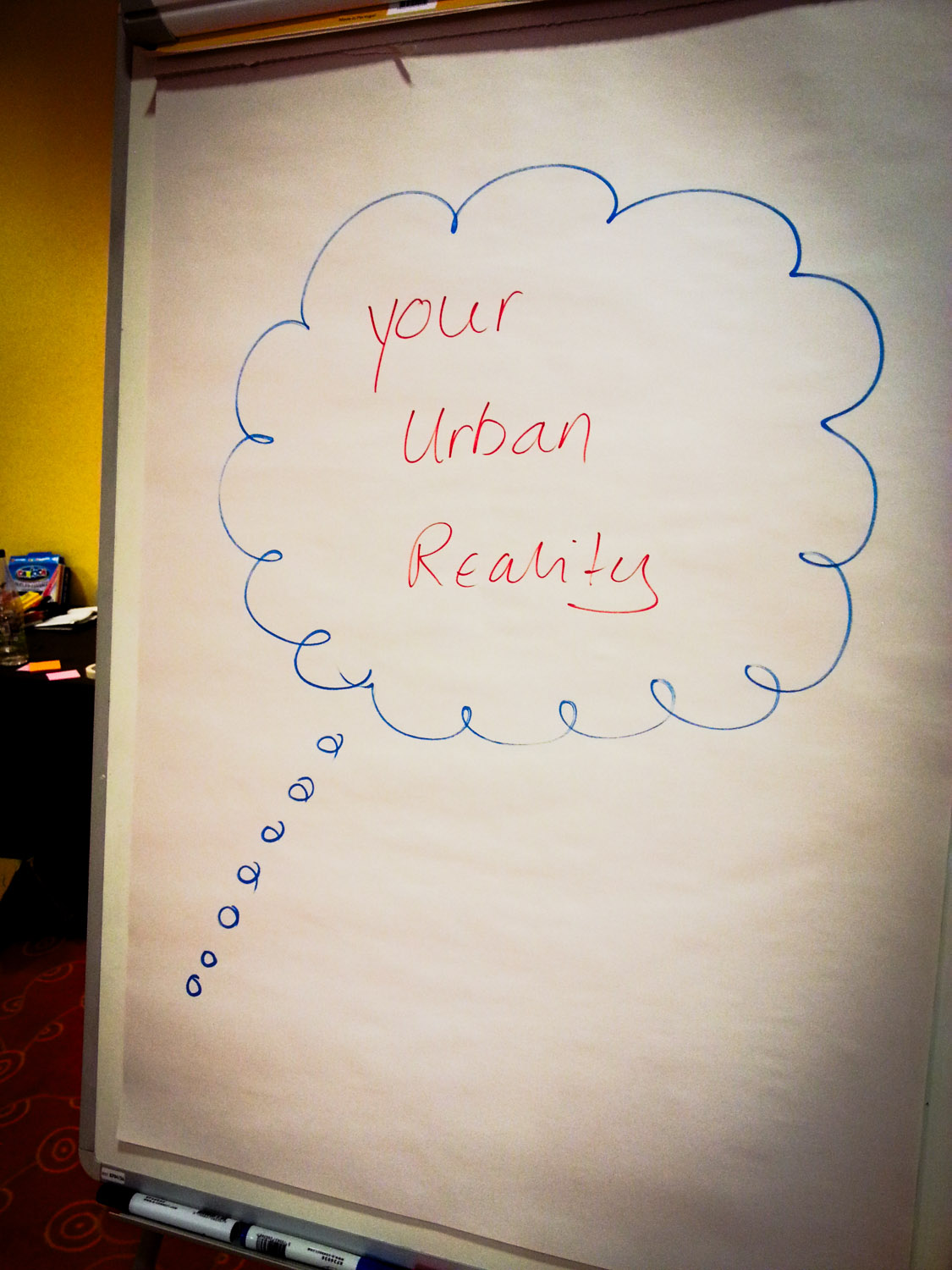 “An example – I work in an area with a lot of social problems, and I work as a ‘dream catcher’. I ask them “what do you most dream about in life?” – they tell me, and I ask them what they want to do about it. I then say “if you want to work on realising your dream, give me a call and we can work on it.”Â
“So today I want to ask you what are your dreams and what is the possible reality for your Urban Reality?”
“So as a group you need to form one flip-chart that has the dreams of your Urban Reality, that can then be presented.”
10.00 : Steve :
Kostas introducing the themes for the entire seminar.
Main Objectives:
• DIALOGUE – to provide a space for young people to get in dialogue with other city stakeholders and discuss “burning†issues;
• ANALYSIS – to get a better understanding of what happened in Athens and other big European cities in last few years (political context behind, institutions involved,…);
• LOCAL – to get to know local reality, through some young people real stories and project visits;
• INTERVENTION – to explore how the voice of young people can be heard, how can we transfer ownership to young people. (share good practices, inspire future action, recommendations,…);
• ACTION – to stimulate future action and follow-up (e.g. action planning, commitment, funding possibilities,…)
09.45 : Steve :
Welcome to the Urban Solutions live blog!
This is where we’ll post anything that requires liveblogging 🙂
Please also see the main blog at http://urbsol2.tumblr.com
09.23 : Steve :
Here’s the audio of this morning’s program overview:
18.00 : Steve :
17.31 : Steve :
a couple more responses to the ‘us and them’/’how to define “we”‘ question:
@solobasssteve #tcMUST We is about ‘Othering’ the concept of defining ourselves against what we are not. Can’t have an ‘us’ without a ‘them’
— EilÃs (@EilisPhillips) May 21, 2013
#tcMUST we are us. all of us.together.all is one. proton electron and neutron.yes maybe and no.the negative has zero say so.
— antonnewcombe (@antonnewcombe) May 21, 2013
V interesting subject.All about what we have in common even if we have completely different cultural baggage #tcMUST
— Joan L (@joanl) May 21, 2013
16.24 : Steve :
The final planning meeting!

15.36 : Steve :
On Twitter, I just threw out a question that came up in our planning for the Training Course:
rich discussion here about identity, and what makes us ‘us’ as opposed to ‘them’. & this is just the planning meeting 🙂 #tcMUST
— Steve Lawson (@solobasssteve) May 21, 2013
Who is ‘we’ to you? National, communal, religious, tribal, cultural? What say you, twitter 🙂 #tcMUST (plz use the tag so we can follow it!)
— Steve Lawson (@solobasssteve) May 21, 2013
Here are the responses 🙂
@solobasssteve Who is ‘we’? That depends on context. Without context it’s impossible to get a right answer.
— Theo (@Crow74) May 21, 2013
@solobasssteve I do a very good talk on that topic as an intro to Social Anthropology. So why wasn’t I invited?
— Joan L (@joanl) May 21, 2013
@solobasssteve All depends on context – Many of us have multiple overalapping identities #tcMUST
— Tim Hall (@Kalyr) May 21, 2013
@solobasssteve The thing that turns a collection of individuals into an “us” is shared values. Things “we” all care about. #tcMUST
— Steve Rumsby (@steverumsby) May 21, 2013
@solobasssteve Example. When Lordi entered Eurovision, being part of rock fandom trumped nationalism, UK rock fans were rooting for them.
— Tim Hall (@Kalyr) May 21, 2013
14.05 : Steve :
We’re currently in a session on the work of Youth In Action, particularly the project funding they offer. Here’s a link to an overview of the Youth In Action program, on the European Commission website, and here’s the YiA guide.
16.29 : Laura Kidd :
Jo – Ketso is designed so we can reuse it – wash it and start again as long as you use the special pens supplied.
Here’s a video showing what’s in a Ketso toolkit:
16.27 : Laura Kidd :
The Youth In Action theme in 2013 is “The year of the citizen”. Jo asks the participants when they’re thinking about their own project ideas to consider how they can make a difference in this area.
The participants have split off in to four groups on separate tables around the room, encouraged to put together a good range of people from different specialisms for the best results:
- political
- business
- social and community
- technology
16.23 : Laura Kidd :
Facilitator, Jo, thinks every delegate here is a leader just like the man in the TED video.
In this session participants are to use Ketso – “The hands-on kit for creative engagement” – to work through ways of getting their projects organised.
16.16 : Laura Kidd :
The afternoon session is starting now with a TED talk from Derek Sivers – “How To Start A Movement”
15.28 : Steve :
Lots of the audio from the talks here now going up on Audioboo – http://audioboo.fm/tag/GreenUrbanLiving
11.55 : Steve :
Laura’s giving a photography masterclass at the moment – here are her 5 tips for great photos for the web.
10.56 : Steve :
We’re going to be watching the film ‘No Impact Man‘ later on. Here are some links about it:
official website: http://noimpactproject.org/
IMDB page: http://www.imdb.com/title/tt1280011/
No Impact Man blog: http://noimpactman.typepad.com/
10.47 : Laura Kidd :
Day 3 has begun, starting with a musical energiser activity and a period of reflection on yesterday’s visits.
00.48 : Steve :
From Marc Hudson, who gave the Skills & Knowledge/Novice Line workshop earlier today – http://askfortheworld.net/2013/01/19/novice-lines-at-the-green-urban-living-event/
15.10 : Steve :
Questions at the end of the the skills and knowledge workshop:

15.08 : Laura Kidd :
Feedback from the group:
DIFFICULTIES : MEETINGS
– language barrier
– lack of information
– no structure / leader (weak leader)
– atmosphere
– logistical / technical
– poor preparation / time limit
THE NOVICE LINE
Positive points
+ to share and show the skills
+ have fun
+ relaxing
+ good ice breaking game
+ get to know each other
Negative points
– people feel embarrassed by making fun
– based on how confident you feel / based on self assessment – not guaranteed
– the definitions should be more precise e.g. music – if you played one instrument you were in the novice line but it should be about how well you play not how many instruments you play
15.03 : Steve :
Answers to the question “What are the obstacles to learning and sharing skills?”
language barriers
cultural conflict
motivation
attitude
external factors
food
sleep
lack of free time
different levels in knowledge
location
clashing opinion
open mindedness
tolerance/respect.
14.41 : Xander :
Connected to this idea of “self assessment” of skills is perhaps the 4 stages of competence
14.37 : Laura Kidd :
Jo is in the very organised ninja group, says she works better when she’s busy and can see connections to projects which help her keep a lot of balls in the air.
14.36 : Laura Kidd :
So far we’ve discovered there are two ninja cooks in the group and approximately equal very organised and horribly disorganised people!
MH – just because you’re not a ninja at something doesn’t mean you can’t be happy about it.
14.33 : Laura Kidd :
If you want to get involved, Manchester Climate Monthly have a list of jobs that need doing…
14.25 : Steve :
The Novice Line:
14.25 : Laura Kidd :
A.S.K. has four levels of Novice – Practitioner – Expert – Ninja – which are you, at what?
14.24 : Steve :
Activist Skills & Knowledge:
14.22 : Laura Kidd :
MH – Slide – ASK – finding out who KNOWS what?
ASK stands for Activist Skills and Knowledge.

14.12 : Laura Kidd :
MH – “Steady state economics” – who believes that you can have infinite growth on a finite planet? We need a “steady state” (no growth) economy.
14.07 : Laura Kidd :
Our first post-lunch session has started with Marc Hudson from Manchester Steady State – participants are encouraged to write down on separate pieces of paper one thing they’re good at and one thing they’re not good at and would like to be good at.
13.02 : Steve :
Campaigning organisations/platforms online:
http://avaaz.org/en/
http://www.change.org/en-GB
http://www.38degrees.org.uk/ (website currently down but shouldn’t be for long.)
13.02 : Laura Kidd :
Your Square Mile is something Envirolution is raising awareness about. How easy is it to access your local facilities? Is your school in a reasonable distance, is your local place to buy food in a reasonable distance? Bob hands out questionnaires for everyone to fill out.
12.58 : Steve :
Grassroots vs global campaigning/lobbying (comments from the floor)
“I believe that lobbying is more important than grass roots – if you look at hte population of cities, most don’t have the time to get informed and to act. So pressure on the political process to make the changes is most important”
“The national conferences have failed, but on a community level, environmental policies do work, especially in countries with democratic/left wing governments. So I think grassroots is as important if not more so.”


12.45 : Laura Kidd :
Great questions from the participants – how do Envirolution keep credible and professional and how do they organise themselves?
Bob – we usually have weekly meetings – used to be in a cheap office space in the city centre, now it’s in peoples houses or at Platt Fields Park. Local people see it’s a good thing we’re trying to do – we’re not another music festival just churning up the park. We add value to work we do through our partner organisations, we’re providing a stage for people to do workshops and start discussions, and run a particular area of the festival. Within the team we all have an interest in environmental matters – I teach at a university and other team members have relevant skills. That’s how we ensure quality in what we do.
Fee – we do shoutouts at the local unis, there are loads of young people with different skills who can lend themselves to us.
12.43 : Steve :
another great link, via @brian_condon on twitter, to Urban Farmers – http://urbanfarmers.com/productsservices/uf-globe/ – the UF Globe looks like an awesome rooftop greenhouse!

12.40 : Laura Kidd :
Once the co-operative was more organised it was easier to look around for little pots of funding, currently Envirolution are in the running for £1500 from the Fallowfield “U Decide” fund – more about that here.
Everyone in the co-operative is involved because they want to be, on a voluntary basis.
12.35 : Laura Kidd :
After the event in 2011 Envirolution became a co-operative, with a constitution and a clear focus. A pop-up farm project was set up – an educational and food growing project aimed at primary school children which has since been taken to festivals. Find out more about the Pop-Up Farm here.
12.29 : Laura Kidd :
The next event was held in June 2011 in Platt Fields Park, run using money Envirolution had raised themselves, so it was a much more independent event. The 2011 fundraising was called Uprising and involved an art auction with work from artists all around Manchester, DJs etc. This raised around £600.
12.28 : Steve :
Envirolution are using Platt Fields Park as their venue – they’ve got involved with a lot of other things that are happening around the park. http://envirolution.wordpress.com/tag/platt-fields-park/
12.26 : Steve :
you can see the presentation we’re watching at the moment here on the blog – http://greenurbanliving.posterous.com/presentation-from-envirolution
12.24 : Laura Kidd :
In 2010 Matt Rowe did a callout to people in the Manchester area interested in doing some environmental projects. Got some funding from MYVP in Manchester, they had money for a community engagement event so Envirolution ran their first event in October 2010.
12.23 : Laura Kidd :
Envirolution is a community cooperative based in Greater Manchester which aims to create a catalyst for environmental and social change. We work with our local communities to create innovative solutions for how we can live more sustainably, improve our work life and be happier. We inspire residents to create a positive future by working from within local neighbourhoods to educate, engage and trial enterprising ideas that will further our collective vision.
11.46 : Laura Kidd :
Joe Hulme presenting his pecha kucha on transforming Greater Manchester Fire and Rescue service in to a Green Service.

11.43 : Xander :
Talking about new, greener systems for fighting fires  – using heat cameras to identify the hotspot at the centre of the fire and then insert a ‘lance’ into the very centre which explodes a burst of water, far more efficiently dousing the fire, with less runoff and wasted water.
11.40 : Laura Kidd :
JH clarifies that the eco volunteers at the fire stations are trained firefighters who sign up to work on green matters alongside their job.
11.39 : Laura Kidd :
JH – In Year 1 we got every single fire station taking part, in Year 2 we want more to take part – stations around the country.
11.39 : Xander :
There is an article on the MCFRS becoming more sustainable and undertaking green project over here.
11.38 : Laura Kidd :
JH – 120 people are signed up to the Green Hose Award scheme now, which features 60 challenges. People are keeping bees and chickens, bringing in young offenders to learn, and generally making the stations more eco friendly.
11.37 : Laura Kidd :
Joe started out as a volunteer at the fire service because he couldn’t find a job, despite having a degree. At that time there was an eco volunteer per station, whose main duties were to turn lights off! He wanted to do more, and since then has been involved in supporting people to put beehives at fire stations, setting up the Green Hose Awards (apparently firefighters are very competitive) and running his own project in Moss Side.
11.31 : Laura Kidd :
Joe Hulme from Greater Manchester Fire and Rescue Service will be doing a pecha kucha presentation – Japanese for “chit chat” – more on the format here.
11.28 : Steve :
Great point from Richard Leese that most of the buildings we’ll have in 2050 are already here, so the big challenge is retrofitting those for energy efficiency/reduction, not just coming up with future tech for new-build projects.
11.17 : Steve :
Joseph Stiglitz on the The great GDP swindle – “Chasing GDP growth results in lower living standards. Better indicators are needed to capture well-being and sustainability” http://www.guardian.co.uk/commentisfree/2009/sep/13/economics-economic-growth-and-recession-global-economy
11.10 : Laura Kidd :
RL – We’re already past the point where we can avoid a 2 degree increase, in the next 30-40 years we’re probably looking at a 4 degree increase. We’re not doing enough.
11.07 : Laura Kidd :
RL – climate change is almost inevitable so we need to learn to adapt. One of the things we’re doing is developing our green infrastructure, cleaning up rivers as we design new areas, changing physical infrastructure in the city to allow us to adapt to living in a warmer place. If you say to people in Manchester we’re going to be 2 degrees warmer they think it’s good news!
11.06 : Steve :
Ooh, another great link from @JYStewart on city action on climate change – http://www.c40cities.org/
11.05 : Steve :
Guardian article from 2005 about US cities doing WAY more on Kyoto targets than the US govt. – http://www.guardian.co.uk/environment/2005/may/17/usnews.climatechange (found via @JYStewart on twitter)
11.03 : Laura Kidd :
Manchester’s Carbon Literacy Programme is being rolled out at the moment – find out more here. 1/3 of Manchester’s schools are signed up, it’s being added to apprenticeships and 2000 businesses are signed up to the Council’s Environmental Business Pledge.
11.01 : Steve :

10.58 : Steve :
Website of the Tyndall Institute For Climate Change Research (partnered with the University of Manchester)
10.57 : Steve :
RL – tech change needs to go hand in hand with behaviour change, to make energy savings meaningful (not leaving windows open or wasting heating in other ways)
10.56 : Steve :
RL – outlining the need for an increase in green energy tech in Manchester and a change in transport use patterns towards walking and cycling. They’re looking at different kinds of changes to energy efficiency in public buildings. All the environmental tech developments produce work. About 35,000 in Manchester are employed in the enviromental tech industry and they expect that to double in the next few years.
10.54 : Steve :
RL – Manchester’s environmental challenge needs to be dealt with pragmatically – we need to acknowledge that we already have high levels of depravation, so need to balance the need for climate action with the need for economic regeneration..
10.50 : Steve :
RL – “Climate change is a global issue, which means that everyone needs to make their contribution – individual, local, city, nation, international. Nation states are, at the moment, really not doing their part – Copenhagen was a farce”
10.48 : Steve :
Richard Leese talking about the things that Manchester is known for – historically it was a world textiles hub, now best known for Football and Music. The first programmable computer was built here, and the first passenger train journey started here…
10.42 : Laura Kidd :
Day 2 is about to kick off with a talk from Sir Richard Lease from Manchester City Council. followed by Joe Hulme on how he transformed Manchester Fire Service in to a Green Service, then Bob and Dawn from Envirolution.
18.20 : Steve :
…how discussing the idea of the utopian ‘green city’ of the future – what sustainable changes need to be made to our cities to make them more environmentally sustainable?
here’s the beginning of one group’s discussions:
17.37 : Steve :
We’ve been looking at many of the presentations that are on the blog in greater detail – please do have a browse. All the powerpoint (.PPT) files mentioned in the post previews are embedded in the post when you click on the title… There are a lot of inspiring Green Living projects outlined in these posts…
11.15 : Steve :
the nations represented here: UK, Denmark, Netherlands, France, Italy, Serbia, Macedonia, Bulgaria, Cyprus, Turkey, Hungary, Austria, Czech Republic, Slovakia, Poland, Lithuania, Slovenia, Finland, Germany… wow!
10.51 : Laura Kidd :
Vanessa from the British Council introduces the Youth In Action programme. Find out more about European Union funded opportunities here.
10.41 : Steve :
Day One of Green Urban Living has started…with a health and safety briefing 🙂
11.40 : Steve :
It’s finally here – arrival day in Manchester for the participants. The venue for the Green Urban Living event is an amazing hotel, in a converted warehouse, all exposed girders and brickwork. Have a rummage around this blog for the kinds of projects the participants are involved in across Europe…
17.11 : Steve :
This here is the live blog – we’ll be posting moment-to-moment updates from the event in Manchester here, and you’ll be able to follow it in a separate window too… Bookmark the site, and come back soon 🙂
10.14 : Reuben Message :
What a week! Contribute, keep listening in, and look for out for updates as the Re-Imagine Youth conversation goes on growing.
16.10 : Reuben Message :
‘The best camera is one you have on you’ – stolen quotes
16.09 : Reuben Message :
Sustaining the conversation: techniques for sharing and responding. Tips from Steve and Laura for the group.
16.04 : Reuben Message :
Rob: your ideas should be like snowballs, enrolling others, and allowing existing structures to support you along the way.
15.56 : Reuben Message :
Sneha asks about sport: there’s plenty money in it – but how do we channel it?
15.52 : Reuben Message :
Owen chips in with his experience interning in India: he was paid by the firm, and he worked hard. But he got a valuable international experience. He point is that to fund exchanges, the initiative has to work for both parties.
15.50 : Reuben Message :
There are no scholarships for UK students to go to India! How can the UK say it is serious about renewing this ‘special relationship’? We need real investment, and a big idea to get it moving.
15.48 : Reuben Message :
The British Council website already has some lists of programmes, schemes and scholarships that are available. Perhaps we can do more, Rob asks, in pulling information about what little funding there is out there together to make access to it easier… But the real challenge is scaling up and generating more finding.
15.46 : Reuben Message :
Rob Lynes, Director of the British Council in India is with us. He is talking of the challenges to finding funding for India-UK programmes.
15.44 : Reuben Message :
Committing to further online collaboration and extending educational networks within the group, especially at the community level.
Question asked: We have loads of experience and resources amongst us, could we use these to set up youth exchanges and volunteering opportunities to areas outside of the major Indian metropoles?
15.37 : Steve :
A search on jstor.org for articles about Historiography – some fascinating resources here!
http://www.jstor.org/action/doBasicSearch?Query=historiography&acc=off&wc=on
15.32 : Steve :
Tweets collected together, in response to this question:
UK peeps, what are your earliest memories of seeing Indian culture in the UK? Mine are Mahabarat and Kabaddi on the TV… #reimagineyouth
http://www.exquisitetweets.com/collection/solobasssteve/1645
15.28 : Reuben Message :
Time for: Best Moments, Suggestions and Recommendations, Personal Commitments and Actions
15.11 : Reuben Message :
Winding down after lunch now. Time for a bit of reflection and feedback from the group.
13.37 : Reuben Message :
The Re-Imagine Youth summit: an experiment in global cultural relations for the 21st century: a face-to-face/virtual multimedia hybrid, imagining new communities and relationships in an increasingly horizontal, interconnected world.
13.33 : Reuben Message :
Democratising the conversation and allowing it to grow and evolve. 200 000 impressions on Twitter so far!
13.29 : Reuben Message :
Steve Lawson is talking about what we’ve done on the social media front during this event: a new vision of events, taking the conversation beyond the walls of the conference.
13.27 : Reuben Message :
Education and questions of access emerging in the conversation now.
Everyone agrees on the need for more scholarships from India to the UK, especially in areas other than the sciences. There are very few undergraduate scholarships in the humanities and the arts. This represents a massive problem for cultural relations.
Visas – the major issue we know we are all skirting – is a dark cloud hovering on the edges of everything we say regarding exchange programmes… How intractable is this problem really?
13.22 : Reuben Message :
Sports continue to be a major theme here. Â Everyone keeps emphasising how much opportunity there remains in this area for collaboration between the UK and India.
Interesting points on sport made from the floor in the importance of sport for sports sake is important. Being to corporate, making it a business, will only work for the Manchester United’s of the world. Also, sports bond communities locally and globally, we know this, but they are not used in this way often enough in India especially.
13.15 : Reuben Message :
Heather is moderating the conversation now.
Points from the floor:
– Can we start from zero again in terms of this relationship? Are people even bothered, in some cases, about the history?
– How can we become more curious about each others cultures? How to get people to care? This must come first.
– The ‘facts’ of history are not all that we need: they need to used well for good working relations now and in the future.
12.49 : Reuben Message :
Our visitors have been split into small groups to discuss the issues as they see them. Our delegates from the UK and India are facilitating their conversations in prep for a feedback session and plenary 😉
12.45 : Reuben Message :
Check out the Re-Imagine project video animation!
12.38 : Reuben Message :
Points being addressed right now:
Poor knowledge of contemporary India in the UK
Value of exchanges between young people
Troubles with history – monolithic visions don’t leave room for plurality
Virtual existence – what will happen to history as documentation of the living relationship goes online
Focus on sports: sports in UK are built into community building projects – not so in India (Olympic fever perhaps?)
12.17 : Reuben Message :
Rob Lynes, director of the British Council in India is giving a welcome speech. He is asking ‘how do we reinvest in the India-UK relationship?’
11.53 : Reuben Message :
Final presentation getting under way shortly. Guests assembling, chatting, and looking at our gallery and slide shows.
14.21 : Reuben Message :
Great points also being made about how to ‘teach’ cultural relations as well. It’s not only about introducing people to other cultures, but about creating the right educational structures to develop open, flexible and well rounded minds. So while AC Grayling’s talk on his New College of the Humanities has provoked real arguments about funding models, he has also inspired thinking about what good schooling could be.
14.19 : Laura Kidd :
Questions for this afternoon:
Where do the historical narratives come from?
What influence do they have?
How could changing the way we think about history improve UK / India cultural relations?
How could this change come about?
14.13 : Steve :
We’re currently discussing the funding of education – here’s Wikipedia’s article on the structure of UK Universities.
14.12 : Steve :
Links to the Edinburgh World Writers Conference
here’s the background on the infamous 1962 conference.
10.38 : Reuben Message :
Great discussion this morning about history and representation. Shame to have to move on, but time presses. Hoping to see some thoughtful responses to the session on the blogs soon!
09.13 : Steve :
Kicking off today with some reflections on the previous day:
“there were 88,000 words in the portrait gallery, but 800 pictures, which showed how powerful pictures are for telling stories. Also the role of portraiture in biography, shedding light on the written word” – Heather
“I like the way we followed a timeline round the museum, of what was considered important in the history of the country – the shift from recognition of wealth, to the power of science and technology, then the emancipation of women, and then multiculturalism.”
“I was interested in the architects – the brief they were given was to make it better, and there’s a parallel with what we’re doing” – owen
“the curator mentioned that the building was beautiful, but they needed to demolish the inside and rebuild it. Similarly the UK/India relationship is beautiful but still needs reconstructing”
“when we were interviewing people in the streets – we met a musician who said a lot of things we’d been saying, but people from science and tech backgrounds gave us irrelevant responses. It seems that understanding background is so important, because those things can make or break our plans. We asked them to talk about culture, and then what do they appreciate about their own culture – the first half they struggled with, but had clearer ideas about the second half, suggesting that many people don’t think about arts and culture in their daily life, it gets buried in the struggle.”
“The inequality in the gallery was a big bugbear of mine. I don’t think the portrait gallery is a fair representation of what Scotland is – they ignored our clan history, our tartans are a part of our sense of identity, and that wasn’t brought out, and that for me is quite sad. I’m really proud to be Scottish, of our culture, and what makes up Scotland. I didn’t see anything that felt like this is what we’re about. Last night, seeing a guy playing bagpipes on the street with people singing and dancing around, people from all backgrounds were joining all, and all judgements were banished. All that mattered was listening to music and having a great time. That’s what’s strong about Scotland. If you got to Glasgow Green on a sunny day, you can meet so many different kinds of people and make friends, and that feels like the real scotland to me, and it didn’t come across in the museum or gallery.” – Stacey
13.55 : Steve :
The society of the antiquaries of Scotland – http://www.electricscotland.com/history/fsascot.htm
12.33 : Reuben Message :
Off to the Portrait Gallery in a mo’ to continue our conversations from yesterday.
11.59 : Reuben Message :
Access remains the major issue, but it is bundled up with culture, habits, values and perceptions.
11.54 : Reuben Message :
It’s about expanding the reach of the relationship: how can we communicate the importance the relationship to ordinary people everywhere? More questions than answers right now!
11.35 : Laura Kidd :
Some thoughts and suggestions from the group:
“We shouldn’t look at partnerships in terms of business/politics but across sectors, we have a lot to learn from each other”
“Most people in India know how to speak English, I think it’s only fair that people over here learn Indian based languages like Hindi and Urdu. Peer to peer learning. Focusing on the youth.”
“UK has a very large developed music industry…India needs to grow a lot in certain areas…we can develop more when you have exchange of musicians…taking folk and tribal musicians from India to UK and the other way round.”
“I think we need to develop interest in school children, we can have magazines, British Council website, we can have penfriends. Aged 12 you know nothing about the world – in schools we can have email addresses from the UK so we can write emails to people in other countries. If I have a friend in the UK and that friend is interested in something else, and they know what I am interested in, then we learn from each other.”
“We are what our experiences have been until now…having a cross cultural experience in childhood truly makes you discover what your passion is. Having seen interactive museums as a child I discovered I wanted to be an engineer, if I hadn’t seen them I would have gone in to the arts or something. It’s a whole new approach to education.”
“We should also encourage teacher exchange programmes – music education is stale and stagnant in our country (India).”
“Q – In England we celebrate Divali…there are all these festivals where we can get insight in to Indian culture…do you have that in India?”
“A – the thing is you have a lot of Indian people living here and we have no British people…in the North east region we are in to rock, blues and jazz music so we are very influenced by UK music, but in other areas tribes and folk music is bigger.”
“What happens in India is that there are so many religions that we celebrate everything – we have Christmas and even Halloween!”
11.27 : Reuben Message :
Right now: from the idea of a good relationship, to the elements that make up the actual relationship today.
10.46 : Steve :
the notes on the current session:


10.43 : Reuben Message :
Tolerating ambiguity and accepting that consensus can be hard to find: a valuable session this morning on what makes a good relationship.
10.24 : Reuben Message :
Does respect alone define a quality relationship?
10.24 : Steve :
the results of the discussion about quality relationships, via Stacey on twitter:
“quality relationship is based ……… Respect, commitment, innovation, openness #reimagineyouth”
10.10 : Steve :
just created a Twitter list of the #reimagineyouth attendees – lemme know if you should be on it but aren’t -Â https://twitter.com/#!/solobasssteve/reimagine-youth
10.02 : Steve :
If you want to follow all the tweets (even if you’re not on twitter) you can follow the hashtag, #reimagineyouth
10.00 : Steve :
question to the group here “A Quality Relationship Is Built On…” – answer it in four words. If you want to join in and add your thoughts, please do post them on twitter with the hashtag #reimagineyouth
09.45 : Steve :
We’re having a feedback session from day 1, collecting emerging themes and suggestions for the rest of the time…
Emerging Themes:
Perspectives – hearing different people’s perspectives on the relationship was really beneficial.
The Importance Of History
The Complexity of our shared history
Scotland’s perspective on the UK/India relationship
The Links between the UK and India – the shared sense of community.
Challenged preconceptions about our own culture
Discovering the big picture of the ReImagine Project
An optimistic approach to culture
Exposure to culture
09.17 : Laura Kidd :
And for anyone else who has never heard the song…
09.15 : Steve :
Starting off day 2 here with a quick round of ‘I Am The Music Man’… with a whole lot of people who don’t know the tune 🙂
12.50 : Reuben Message :
question: what would Scottish independence mean for the UK India relationship?
12.34 : Reuben Message :
Crispin: religious, ethical and political influence of India on Britain and Scotland is very hard to overestimate.
Stephan: And it is not over. We are only at the beginning of a new chapter in this story.
12.21 : Reuben Message :
Crispin: fascinating – style of argumentation and debate shared between UK and India, not so with Far East, even parts of Europe. Helps to explain ongoing strength of many forms of research links and political culture.
12.19 : Reuben Message :
(Crispin is from dept of South Asian studies Uni of Edinburgh)
12.18 : Reuben Message :
Crispin Bates: Pointing out English-Scottish differences and contradictions in the tenor of colonial experimentation historically.
12.10 : Reuben Message :
Stephan Roman: Sense of Indian supplication re UK has fundamentally changed in recent years. But have we all kept in step with changes?
12.10 : Steve :
Steven: “We’re like family in a lot of ways, we can be passionate about some things and take other things for granted, and we go through periods of reinvention. The ReImagine project is about doing exactly that”
12.09 : Steve :
Steve “India is now one of the biggest investors in the UK, and the music, film and food have influenced us immensely.”
12.08 : Steve :
Steve “the UK/India relationship is complicated because of what’s happened in the past. the first Brits arrived there in the 16th century. One of the first ambassadors was Sir Thomas Roe, who was part of the court of King James, and drank wine with The Emperor Jahangir.
“We go through the history of the East India company, both good and bad, and through the the Raj, and the romantic image of India that grew up around that, and on to the post-Imperial period. though the collonial relationship lasted beyond independence, that’s now fundamentally gone, and perhaps Britain is now more of a supplicant to India.”
12.05 : Steve :
Steven “the BC was founded in 1934, and one of the main drivers was to oppose the rise of Nazi ideology. And after the war we carried on promoting values from the UK behind the iron curtain and across africa.
Now we’re the UK’s prime education and outreach organisation. Using the arts, language and education as touchstones for a dialog and understanding. WE are represented in over 100 countries round the world, and have 9 offices in India, having been there since 1948. We’re known for our libraries in India. “
12.03 : Steve :
Steven “in the 21st C, we’re looking at all aspects of the UK-India relationship changing. WE have a rich heritage, but we’ve forgotten large sections of our shared history. A lot of our Indian colleagues sensed a collective amnesia in the UK, perhaps trying to forget aspects of the Empire.
So within the REimagine project we have three strands – memory, modernity and future. Which is why you, as those who will live that future, are so important”
12.01 : Steve :
Steven Roman “I’m with you for the next few days. My role is I’m regional direct for the BC for south Asia. I get to India quite a lot, though have never worked there. Last weekend I was in Agra, and finally got to see the Taj Mahal.
“It’s great that you’re all here, this is a really important phase of the project, but the concept of rethinking the relationship btween the UK and India began about a year ago. Culture and Cultural relations are extremely important in today’s world. Alongside politics and business, culture is going up the agenda – what the US call ‘soft power’. People to people contact, that sidesteps govt, has become vital. The internet is breaking down barriers in extraordinary ways. The dynamics of those communications is extremely important. And we’re talking about all that, not just the exchange of art programs etc.”
11.58 : Steve :
Lloyd – the UK-India relationship – India is a priority for the scottish govt. We have the Scottish opera going out to India, we’ve got Indian musicians coming to Celtic Connections – there’s a lot of cultural exchange going on. For scotland it’s about contemporary culture, the cross over of traditional and experimental, how we both deal with our traditions and make them contemporary. So my hope for that relationship is that it’s a shared journey.”
11.56 : Steve :
Lloyd – I worked in Delhi, and at that point there were huge aid projects – I managed £18 million, working on Leprosy, cholera, TB..
…and like the UK, India is not one homogenous thing. The british have idealistic notions about India. We used to have a program called Goodness Gracious Me, which mocked the way we viewed india by turning it around. We do have a very romantic notion of India. Last time I was in Delhi, I saw the huge call centres… this is development, but somehow it makes us sad…”
11.54 : Steve :
Lloyd Anderson – what I’m proud of about the UK.
“did you see the Olympic opening? A fantastic, confusing jumble of all the amazing things that make up Great Britain. I really enjoyed it, I loved the messiness of it, that you were left at the end wondering what on earth it was about. The British don’t like being defined, and the Scots/Welsh/English have ambivalence about parts of their identity, but we’re proud of that”
11.52 : Steve :
Back from coffee break, with a few guests:
Lloyd Anderson
Steven Roman
Crispin Bates
(details to follow 🙂 )
11.50 : Steve :
We’re discussing here things hat we’re proud of about our communities and countries. I asked the same question on twitter. Some answers:
@joannejacobs: I’m proud of my friends [she’s from Australia]
@mcfontaine: Bletchley Park, Alan Turing, Jerry Roberts, Tommy Flowers, Billy Gray of the Ox & Bucks. All the great bands we produce. [from the UK]
@kuks: Proud of totally awesome grandparents who are doing a great job of being supportive in a changing society! [from India]
@solobasssteve (me) : 1 of the few things I’m proud of about Britain is our history of dissent. we’re good at kicking back against abuses of power [from the UK]
@markwallace: that we can do something as creatively unique as Danny Boyle’s opening ceremony. And then embrace it, rather than slag it off. And in so doing, revitalise the communal values we hold as a nation. (Leftie multicultural crap?!) [in UK, posted via app.net]
 Photos from the morning so far are up!
 10.06 : Steve :
Objectives for the event:
- Explore The Future of the India-UK relationship
- Visit organisations and events in Edinburgh
- Network and share ideas
- Present and discuss outcomes
10.02 : Steve :
Themes emerging from the opening discussion:
Openness – 5 people used the word in their desired outcomes.
Creative – a lot desire for the process to be a creative one.
Quirky
Neutral
Knowledge of the countries – Indian participants wanting to learn more about the UK, particularly Scotland.
“I will share India” – an offer.
To learn more about cultural relations – what is it, why is it important?
To experience Scotland and Scottish culture.
09.20 : Steve :
photos from the event will be appearing in the widget on the ReImagine posterous site, and on Flickr here.
09.07 : Steve :
here’s the page on the British Council India website about the Reimagine project, for more info – http://www.reimagine.britishcouncil.org.in/index.php/initiatives/debate-and-dialogues/edinburgh-youth-summit
08.47 : Steve :
All the participants have arrived at the hotel/conference centre in Edinburgh. Wifi has been sorted out, and tea/coffee is here. #Priorities 🙂
01.06 : Steve :
…No, honestly, I didn’t ask them to pose for this – it’s like a still from a Harold Pinter play!
getting set up for tomorrow at the hotel… 🙂

15.22 : Steve :
Putting the final touches to the program 🙂

12.24 : Steve :
Hi all – this is the liveblog for the Reimagine event in edinburgh – check back over the next 5 days for live updates – we start tomorrow morning. Please have a browse around the various posts here – there’s a lot of great information!